Permits, insurance & neighbors
Tree on the property line: who pays to remove it?
A tree belongs to the owner of the land where its trunk stands. If the trunk sits wholly on your neighbor’s side, it is their tree and normally their cost to remove, even if branches hang over your yard. If the trunk straddles the line, it is usually a shared boundary tree: both owners own it, both share responsibility, and neither should remove it without the other’s agreement. Branches that cross onto your property can generally be trimmed back to the line, at your own cost, as long as you do not harm the tree.
These are the common rules in most U.S. states, but tree law is set by each state and sometimes by local ordinance. Treat this as a map of the questions, not legal advice.
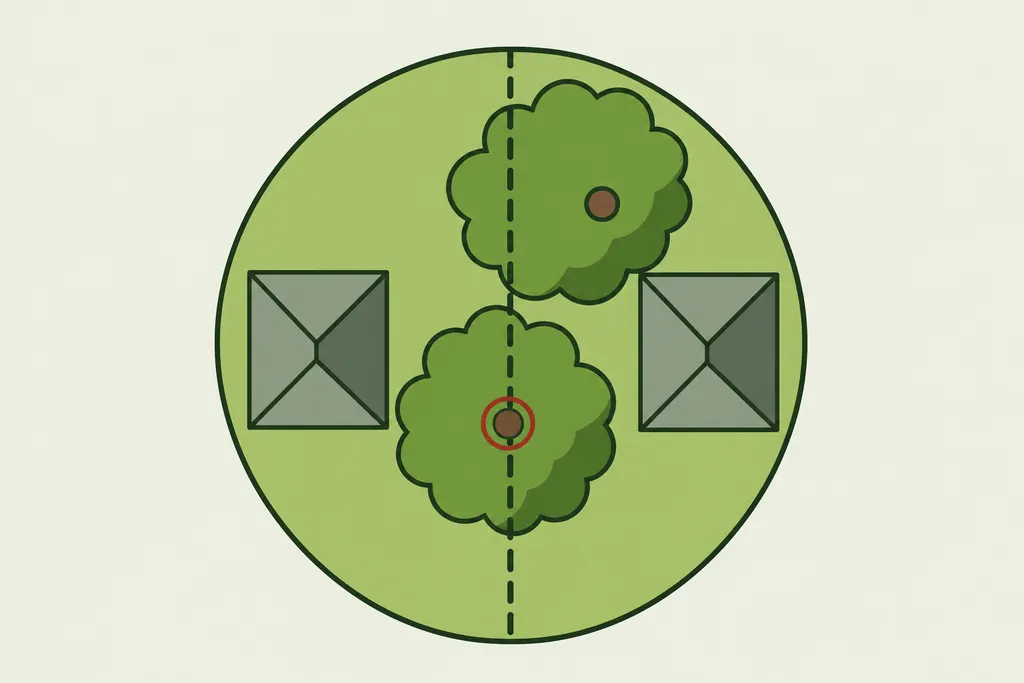
Whose tree is it?
- Trunk entirely on one side: that owner’s tree, even if most of the crown hangs over the neighbor’s yard.
- Trunk across the line: a boundary tree. Clark County’s guidance, drawn from common rules, says all the owners own it and share responsibility, and removing it without everyone’s consent is unlawful.
- Roots and branches crossing the line do not change ownership.
Not sure where the line is? A survey or your plat map settles it. Fences are not always on the line.
Overhanging branches
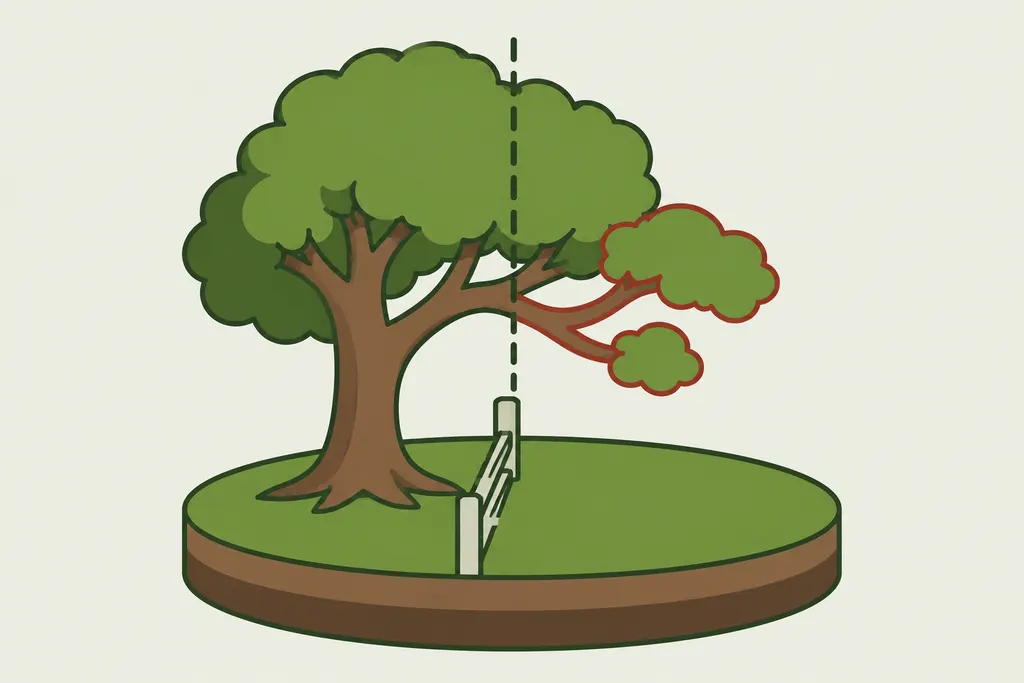
In most states you may cut branches and roots that cross onto your land, up to the property line, without asking. The usual limits, as Clark County in Washington and state law libraries describe them:
- Cut only up to the line, not beyond it.
- Do not go onto the neighbor’s land, or into the tree, without permission.
- Do not cut so much that you kill or seriously damage the tree. Some states multiply the damages for harming someone else’s tree without lawful authority; Washington’s statute, RCW 64.12.030, triples them.
- You normally pay for the trimming you choose to do.
Telling your neighbor first is courteous and often avoids a dispute. A tree service may also need access from their side to work safely.
Who pays for removing a shared tree
For a boundary tree, there is no automatic split. Most neighbors agree to share the cost, often half each, and agree on who hires the crew. Put it in writing before work starts.
- Both owners agree, in writing, that the tree will be removed.
- You have agreed on how the cost is split, including the stump and hauling.
- One person is named to hire and pay the tree service.
- The city has confirmed whether a permit is needed.
- The tree service has shown proof of liability and workers’ compensation insurance.
- Both owners have a copy of the written quote and the agreement.
When a neighbor’s tree falls on your property
If a healthy tree falls in a storm and the owner had no reason to expect it, courts generally treat it as an act of nature. You claim on your own homeowners policy for damage to your property, whatever side the tree came from. If the tree was dead or visibly failing and your neighbor knew or should have known, the neighbor can be liable, and your insurer may try to recover its payment from the neighbor’s insurer, a step the Insurance Information Institute calls subrogation. Our insurance guide explains the usual limits.
If you are worried about a neighbor’s tree
- Talk first. Many owners do not know a tree is in trouble.
- Put it in writing. A dated, polite letter or email noting the problem shows the neighbor was told. That record matters if the tree later falls.
- Get an arborist’s opinion. A written assessment carries more weight than your own view.
- Check local rules. Some cities can order the removal of a hazardous tree.
- Mediation through a community mediation service is often quicker than court.
City-owned street trees
Trees in the strip between the sidewalk and the street often belong to the city, even though you mow around them. Cities usually handle their pruning and removal, and many forbid homeowners from cutting them at all. If a street tree looks dangerous or its roots are lifting your sidewalk, report it to your city’s public works or urban forestry office instead of hiring a crew.
Leaves, fruit and shade
Falling leaves, needles, nuts and fruit are generally treated as a natural nuisance that neighbors must put up with. Shade alone is rarely grounds for a claim. Where branches hang over your yard, you can usually trim them to the line, but the fruit on them is still your neighbor’s in many places. Rules on these small points differ by state, so ask before you pick.
Common questions
Can I cut down a tree on the property line?
Not on your own, in most states. A boundary tree is shared, and removing it without consent can expose you to damages.
Do I have to pay to trim my neighbor’s branches?
If you choose to trim branches over your yard, the cost is usually yours. If the branches are dead and threatening your property, ask your neighbor to handle it and put the request in writing.
Can I make my neighbor remove a healthy tree?
Generally no. A healthy tree that only drops leaves or shades your yard is rarely something a court will order removed.
What if roots from the neighbor’s tree damage my driveway?
You can usually cut roots at the line, but cutting large roots can kill or destabilize the tree, and that can make you liable. Talk to an arborist and your neighbor first. See tree roots and your foundation.
Read next
- Permits, insurance & neighbors Does homeowners insurance cover tree removal? When a homeowners policy pays to remove a fallen tree, the usual limits, when you pay yourself, what happens with a neighbor's tree, and how to file.
- Permits, insurance & neighbors Do you need a permit to remove a tree? When cities and counties require a tree removal permit, the usual trunk-size triggers, what permits cost, exceptions for dead trees, and how to check your own rules.
- Safety & tree health Tree leaning toward the house: when it is dangerous How to tell a long-standing lean from a dangerous new one, the warning signs to look for from a distance, who should assess it, and what removal near a house costs.
Sources (7)
- Nolo Tree disputes with neighbors FAQ nolo.com (opens in a new tab)
- American Bar Association Trees: a unique branch of law americanbar.org (opens in a new tab)
- Texas State Law Library Neighbor tree invasion FAQ sll.texas.gov (opens in a new tab)
- Clark County (WA) Public Works Forestry What can I do when a neighbor's tree branches overhang my property? (PDF) clark.wa.gov (opens in a new tab)
- Washington State Legislature RCW 64.12.030: injury to or removing trees, damages app.leg.wa.gov (opens in a new tab)
- Insurance Information Institute I.I.I. provides information on insurance for fallen trees (press release) prnewswire.com (opens in a new tab)
- Maryland Insurance Administration What to do if a tree falls on your property insurance.maryland.gov (opens in a new tab)
About the pictures on this page: they are AI-made diagrams drawn to explain tree work, not photographs of a real yard, tree, crew or job.