Permits, insurance & neighbors
Do you need a permit to remove a tree?
Many U.S. cities and some counties require a permit to remove a tree on private land once its trunk passes a set width, usually measured 4.5 feet above the ground. The trigger can be as small as 6 inches (Newton and Cambridge in Massachusetts) or as large as 19–24 inches for protected and heritage trees (Austin, Texas, and Dublin, California). Plenty of towns have no rule for private yards at all. Where a permit is needed, cost guides put the fee at roughly $60–$150, though some cities charge more or ask for replacement trees.
The only reliable answer is your own city or county code. This page shows how the rules usually work and how to check yours in a few minutes.
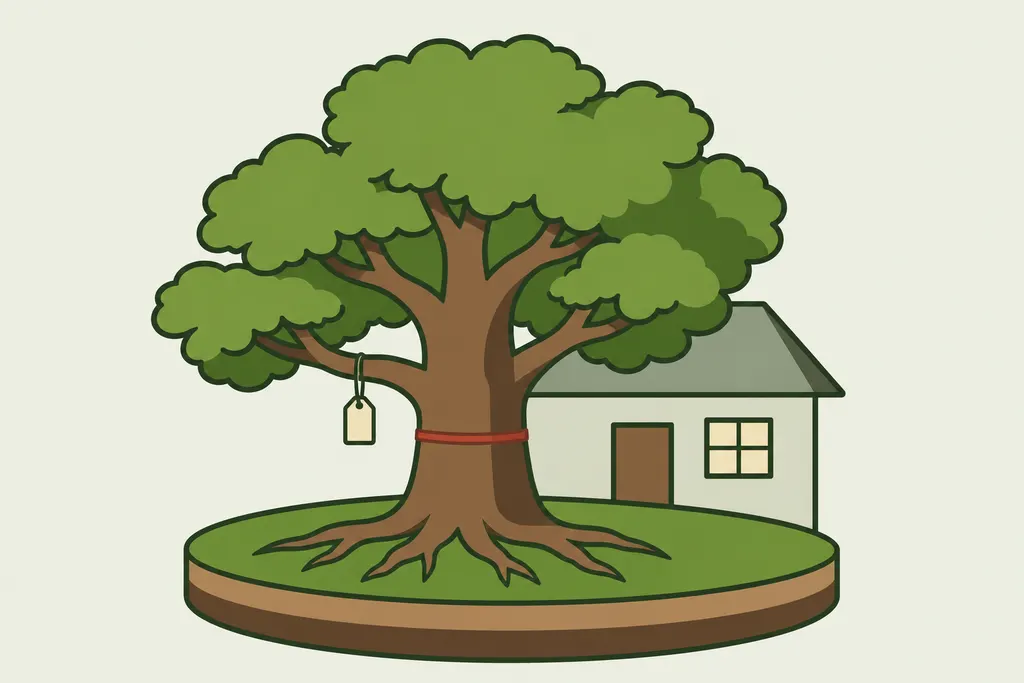
Who requires a permit
Rules for trees in private yards are almost always set locally, by a city, county or town, and they vary a lot. Common patterns:
- Cities with tree preservation ordinances set a trunk-size threshold for private property and require a permit above it.
- Heritage or protected tree lists cover large trees of certain species, such as oaks, and may forbid removal except for safety.
- Historic districts and coastal or hillside zones often have stricter rules.
- Homeowner associations may need approval even where the city does not.
- Street trees in the strip between sidewalk and curb usually belong to the city, and only the city can remove them.
Example cities
Slide to your trunk width to see which of these example cities would want a permit. Then check your own city: these are examples, not a national rule.
| City | Permit needed from | Fee | Notes |
|---|---|---|---|
| Austin, TX | 19 in. (protected) | See city | Heritage status from 24 in. for listed species such as oaks and pecans; removal is prohibited unless the city code allows it, usually through a variance. |
| Santa Cruz, CA | 14 in. (heritage) | $50 first tree, $20 each extra, plus a 6% surcharge | Non-emergency applications. |
| Newton, MA | 6 in. | No fee for 6–39 in. on an occupied one- or two-family lot with no construction planned; $150 otherwise | Replacement planting or payment may be required. |
| Cambridge, MA | 6 in. (significant tree) | No permit fee; mitigation of $850 per inch of trunk (10% of that with a residential exemption) | Measured 4.5 ft above ground. |
| Grass Valley, CA | over 10 in. | No fee for 10–24 in. with mitigation; fee schedule from 24 in. | Private land. |
| Dublin, CA | 24 in. (listed species) | See city | Heritage species are oak, bay, cypress, maple, redwood, buckeye and sycamore. |
Sources: City of Austin, City of Santa Cruz, City of Newton, City of Cambridge, City of Grass Valley, Dublin Municipal Code.
Common triggers
- Trunk width. Almost always measured at 4.5 feet above the ground, called diameter at breast height. To get the diameter, measure around the trunk with a tape and divide by about 3.14.
- Species. Native oaks, sycamores and other listed species are often protected at smaller sizes.
- Location. Trees near streams, on steep slopes, or in front setbacks can be covered even when backyard trees are not.
- Number of trees. Some towns limit how many trees can come down in a year, or let a small number go without review. Read the ordinance for yours.
What permits cost
Fixr lists permit fees at $60–$150, Angi’s sample quote shows $60–$150, and Today’s Homeowner gives $150–$200 where required. City examples range from no fee at all to $150 or more, and some cities add replacement planting or a per-inch payment on top. Santa Cruz, for example, charges $50 for the first tree and $20 for each additional tree, plus a 6% technology surcharge. Newton charges nothing for most removals on an occupied one- or two-family lot but $150 when construction is planned or the trunk is 40 inches or wider. Cambridge issues the permit free but charges mitigation of $850 per inch of trunk, cut to a tenth of that for homes with a residential exemption.
Many tree services pull the permit for you. Ask whether their quote includes it.
What a permit application usually asks
Applications are usually short. Expect to give:
- The address and the owner’s name, and the tree service’s name if it is filing.
- The species, trunk width at 4.5 feet, and a photo of each tree.
- A simple site sketch showing where the tree stands.
- The reason for removal, such as dead, diseased, storm-damaged, or too close to the house.
- Sometimes an arborist’s report, especially for protected or heritage trees.
- Your plan for replacement planting, if the city requires it.
Cities that require replacement often set it by trunk size, for example one new tree for each removed tree over the threshold, or a payment into a city tree fund instead.
Dead or hazardous trees
Most ordinances make room for dead, dying or dangerous trees, but “exempt” rarely means “no paperwork.” Many cities still ask for a photo, an arborist letter, or notice within a few days of an emergency removal. After a storm, take photos before the tree is cut so you can show why it had to go.
Fines for removing without a permit
Penalties can be steep, sometimes set per inch of trunk removed, and may include replanting. In some places the company doing the work can be penalized as well, which is one reason careful tree services ask about permits before they quote.
How to check your own city
- Search for your city or county name plus “tree ordinance” or “tree removal permit”.
- Find the trunk-size threshold and whether your species is protected.
- Check whether your property is in a historic district or special zone.
- Ask your HOA, if you have one, about its own approval process.
- Measure your trunk at 4.5 feet and write it down.
- Ask the tree service whether its quote includes filing the permit.
Common questions
Do I need a permit to cut down a tree on my own property?
It depends entirely on your city or county. Many places have no rule for private yards, while others require a permit above a trunk-size threshold.
Who files the permit, me or the tree company?
Either can, depending on the city. Many tree services handle it as part of the job. Make sure someone is named in writing.
How long does a permit take?
From same-week approvals for simple cases to several weeks where a city arborist must inspect. Ask your city for its typical timeline.
Do I need a permit to trim a tree?
Usually not for normal pruning, though some cities regulate heavy pruning of protected trees. Check the same ordinance.
What about a tree on the property line?
You will usually need your neighbor’s agreement as well as any permit. See tree on the property line.
Read next
- Costs & pricing Tree removal cost: what you'll pay by height, type and job What tree services charge to cut down and haul away a tree: prices by height, species and state, the extras that change a quote, and how to compare two bids.
- Permits, insurance & neighbors Tree on the property line: who pays to remove it? How shared boundary trees, overhanging branches and a neighbor's fallen tree are usually handled, who pays, and how to put an agreement in writing.
- Safety & tree health Dead tree: signs it is dying and what removal costs How to tell whether a tree is dead, dying or only dormant, why dead trees are riskier to take down, what removal costs, and when it can wait.
Sources (9)
- City of Austin Tree reviews and permitting (City Arborist) austintexas.gov (opens in a new tab)
- City of Santa Cruz Urban Forestry santacruzca.gov (opens in a new tab)
- City of Newton Tree Preservation Ordinance newtonma.gov (opens in a new tab)
- City of Cambridge Apply for a tree removal permit cambridgema.gov (opens in a new tab)
- City of Grass Valley Tree removal permit grassvalleyca.gov (opens in a new tab)
- City of Dublin (CA) Municipal Code Chapter 5.60 codepublishing.com (opens in a new tab)
- Fixr Tree removal cost: permits updated Jan 31, 2025 fixr.com (opens in a new tab)
- Today's Homeowner Tree removal cost: permits updated Sep 3, 2025 todayshomeowner.com (opens in a new tab)
- Angi How much does tree removal cost 2026 data angi.com (opens in a new tab)
About the pictures on this page: they are AI-made diagrams drawn to explain tree work, not photographs of a real yard, tree, crew or job.