Tree roots and your foundation or pipes
Tree roots rarely break through a sound foundation or an intact sewer pipe. Roots follow water and air. They grow into cracks and leaky joints that already exist, and they can make those problems worse. The bigger threat to foundations usually comes from shrinking clay soil: in long dry spells, clay loses water, shrinks and lets a foundation settle, and a thirsty tree nearby can speed that drying. If you see new cracks, have an engineer look at the foundation and an arborist look at the tree before anything is cut.
Removing a healthy tree is not always the fix, and cutting big roots can make a tree unstable. Here is how to sort out what is going on.
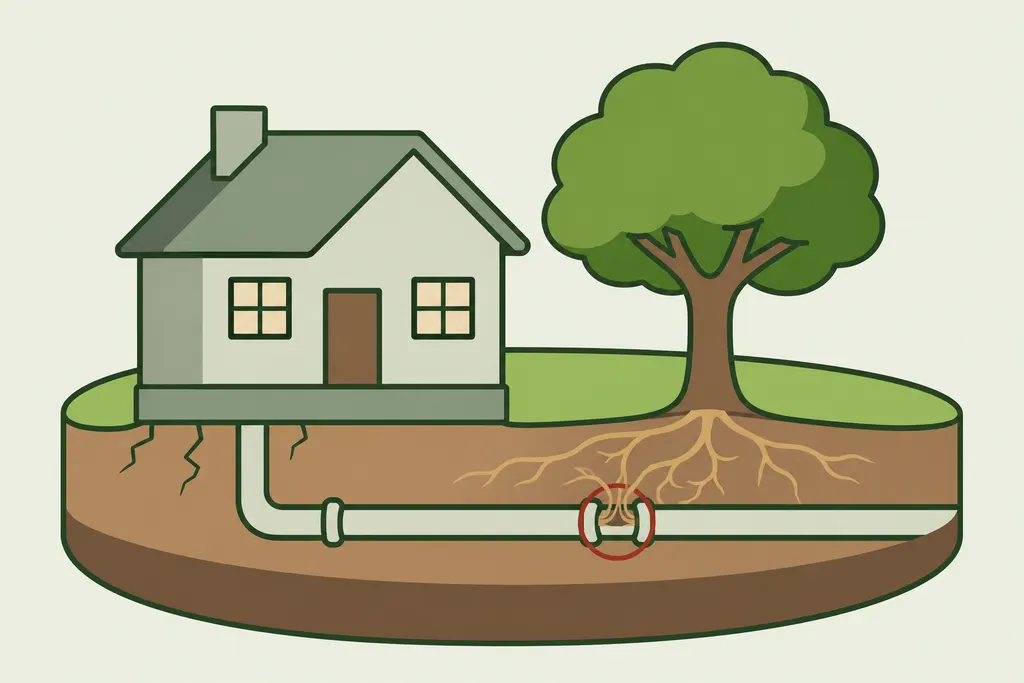
Can roots damage a foundation?
Sources agree on the basic picture:
- The Montréal Botanical Garden’s guidance says trees are rarely behind foundation trouble; settling on clay happens mainly in long, dry summers, and many things besides roots dry out clay. It adds that a tree should not be blamed for cracks until the case has been looked at on its own.
- The Royal Horticultural Society notes that tree-related subsidence is generally a problem only on shrinkable clay; gardens on sand or chalk are very unlikely to see it.
- A University of Washington horticulture library answer cites a home inspectors’ association: under normal conditions roots cannot push through a foundation, though they can find their way into cracks that are already there.
So the soil type matters. On sandy or rocky ground, a tree near the house is rarely a foundation threat. On expansive clay, a big, thirsty tree close to a shallow foundation is worth an expert look.
Signs to watch
- New or widening cracks in the foundation, especially stair-step cracks in block walls.
- Doors or windows that start to stick on one side of the house.
- Gaps opening between the walls and floor or ceiling.
- Slow drains or gurgling toilets that keep coming back.
- A soggy patch or unusually green strip of lawn over the sewer line.
- Sidewalk or driveway slabs lifted near a tree.
Cracks in a foundation have many causes. Tick what you see and bring the list to the engineer or plumber.
Sewer and water lines
Roots are drawn to the moisture and nutrients that leak from a cracked pipe or a loose joint. Once inside, fine roots can grow into a mat that blocks the line. The Royal Horticultural Society makes the same point from the other side: leaking drains are the risk, and watertight ones are generally left alone. A plumber’s camera inspection shows whether roots are in the line and where.
Clearing roots from a sewer line is a plumbing job. The lasting fix is repairing or lining the damaged section so roots have nothing to find.
Options short of removal
- Fix the pipe. A sealed or lined sewer line stops attracting roots.
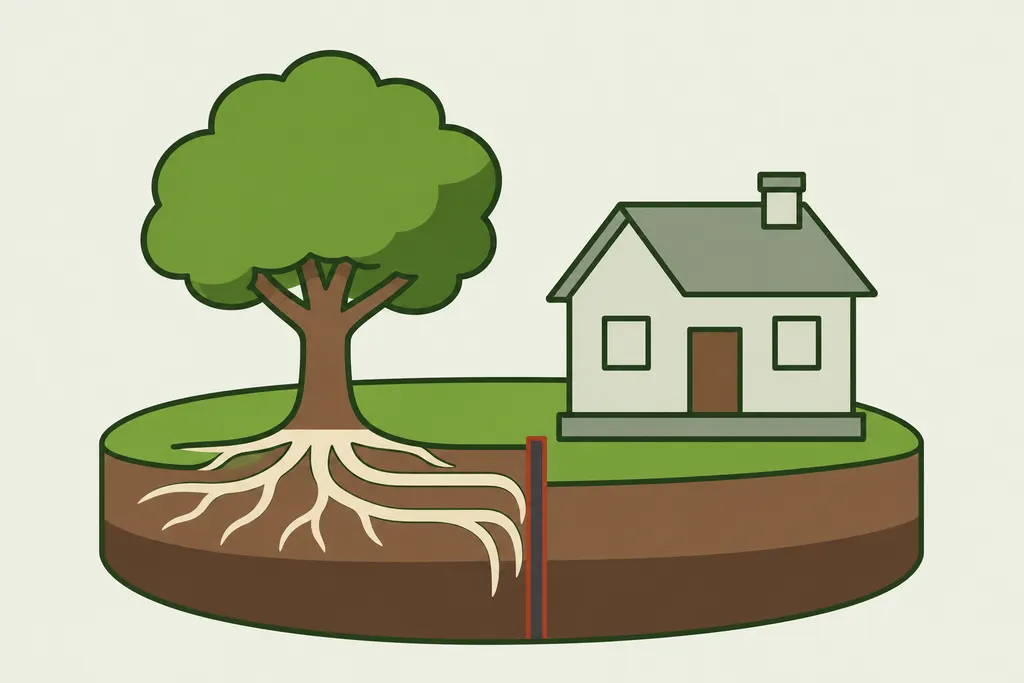
- Root barrier. A vertical barrier installed in a trench between the tree and the foundation or pipe can steer roots downward. It is most effective when installed before roots arrive.
- Root pruning by an arborist. Cutting selected roots can relieve a sidewalk or pipe, but cutting large roots close to the trunk can kill or destabilize the tree. NC State Extension notes that a tree whose roots were cut during grading can take up to five years to die.
- Watering in drought. On clay soil, keeping the soil moisture steady can reduce shrink-swell movement.
Before any digging, call 811 so buried utility lines are marked; the Ohio Consumers’ Counsel recommends doing it at least 48 hours ahead.
When removal makes sense, and what it costs
Removal is reasonable when the tree is very close to the house on clay soil and an engineer links it to movement, when the tree is in decline anyway, or when repeated sewer repairs keep failing because of it. Expect the normal height-based removal price, about $450–$1,200 for a 30–60 ft tree, plus the stump.
For root problems, full stump removal often makes more sense than grinding, because it takes the main roots out too. The middle of five price guides puts digging out an average stump and its roots at about $200–$525, against $2–$5 per inch for grinding. Surface roots can also be ground separately for about $100–$200 per hour.
Removing a big tree from clay soil can also let the soil swell back as it rewets, pushing the foundation up, a movement called heave. The Royal Horticultural Society says this is rare and mostly a risk where the soil has stayed dry for a long time, but it is another reason to get an engineer’s view before removing a large, old tree right next to a house.
Who to call
- Structural engineer: for foundation cracks and movement.
- Plumber with a camera: for slow drains and suspected roots in pipes.
- Certified arborist: for the tree’s health, roots and whether pruning or a barrier can work.
- Insured tree service: for removal, once the decision is made.
Common questions
How far from the house should a tree be?
It depends on the species and soil. North Dakota State University Extension, quoted by the University of Washington’s horticulture library, suggests keeping large trees such as oaks, maples and lindens at least 20 feet from a foundation, with small trees closer. On shrinkable clay the Royal Horticultural Society notes that a thirsty tree can dry the soil out to a distance about equal to its height. Ask a local arborist or extension office for your area.
Does homeowners insurance cover root damage?
Usually not. Gradual damage from roots, settling or soil movement is a common exclusion. Check your policy.
Will cutting the roots kill the tree?
It can. Removing large roots near the trunk can starve the tree or make it unstable. Let an arborist decide which roots can go.
Do some trees have more aggressive roots?
Fast-growing, water-loving trees such as willows and poplars are known for seeking out moisture. Whatever the species, a sound, sealed pipe is the surest defense.
Read next
- Costs & pricing Stump grinding and stump removal cost What grinding a stump costs per inch, the usual minimum charge, extra stumps, root grinding, and how full stump removal compares.
- Permits, insurance & neighbors Tree on the property line: who pays to remove it? How shared boundary trees, overhanging branches and a neighbor's fallen tree are usually handled, who pays, and how to put an agreement in writing.
- Safety & tree health Dead tree: signs it is dying and what removal costs How to tell whether a tree is dead, dying or only dormant, why dead trees are riskier to take down, what removal costs, and when it can wait.
Sources (7)
- Espace pour la vie (Montréal Botanical Garden) Tree roots and building foundations espacepourlavie.ca (opens in a new tab)
- Royal Horticultural Society Trees near buildings rhs.org.uk (opens in a new tab)
- University of Washington Elisabeth C. Miller Library Magnolia tree root systems and damage potential depts.washington.edu (opens in a new tab)
- NC State Extension (Caswell County) Is my tree dying? caswell.ces.ncsu.edu (opens in a new tab)
- Fixr Stump grinding cost updated Jan 31, 2025 fixr.com (opens in a new tab)
- LawnStarter Stump grinding cost updated Oct 5, 2026 lawnstarter.com (opens in a new tab)
- Office of the Ohio Consumers' Counsel Utility line clearing and tree trimming occ.ohio.gov (opens in a new tab)
About the pictures on this page: they are AI-made diagrams drawn to explain tree work, not photographs of a real yard, tree, crew or job.