Permits, insurance & neighbors
Does homeowners insurance cover tree removal?
Homeowners insurance usually covers tree removal only when a covered event, such as wind, lightning or the weight of ice, knocks a tree onto a covered structure like your house, garage or fence. In that case the policy typically pays to repair the structure and to remove the tree from it, minus your deductible. The removal part has its own cap, commonly $500 per tree and $1,000 per claim on long-used standard policy forms, and higher on some newer ones. A tree that falls in the yard without hitting anything, or one you remove because it is dead or in the way, is usually your own cost.
That is the general pattern across standard policies. Your own policy wording decides, so read the “debris removal” and “trees, shrubs and other plants” sections, or ask your agent.
When the policy pays
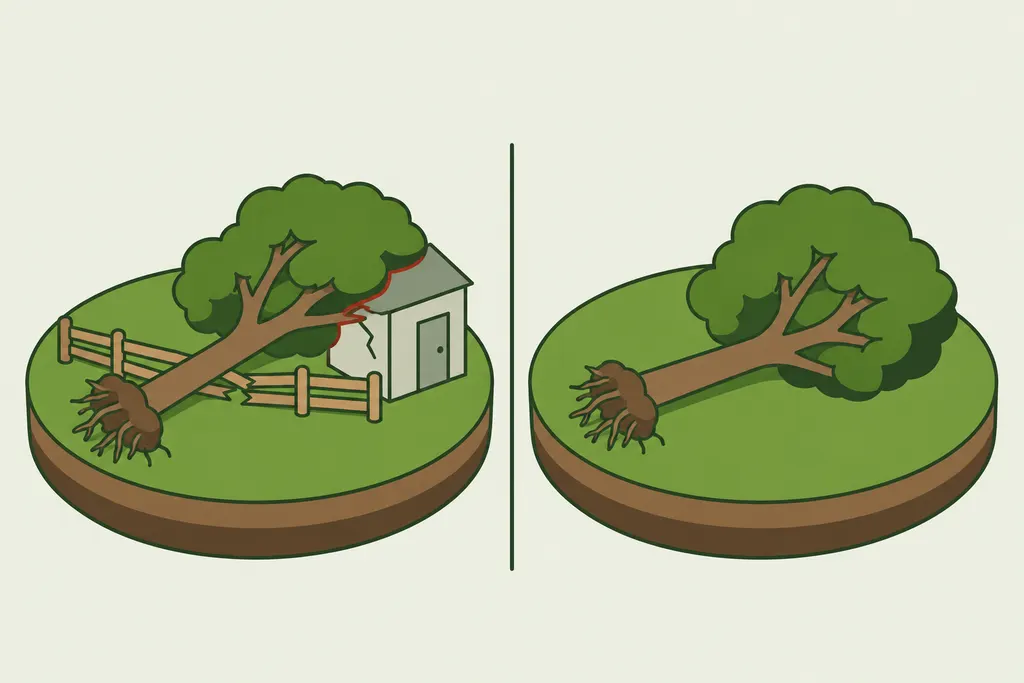
Coverage usually needs two things at once:
- A covered cause. Wind, lightning, hail, ice and snow load, fire and vehicle impact are covered perils on most standard policies. Floods and earthquakes are usually not, unless you bought that coverage separately.
- Damage to something insured. The dwelling, a detached garage, a shed or a fence. Once the tree hits one of those, removing it becomes part of fixing the damage.
In that case, the structure repair is paid under the dwelling or other-structures part of the policy, and the cost of getting the tree off and away is paid as debris removal, up to its limit.
Typical limits for tree removal
The Insurance Information Institute puts typical tree removal coverage at about $500 to $1,000, depending on the insurer and the policy. Those figures come from the standard homeowners form used by many insurers, which pays up to $1,000 per loss for fallen trees and no more than $500 for any one tree. The 2022 edition of that form raised the caps to $3,000 per loss and $1,500 per tree, but insurers and states adopt new editions at different times, and many write their own wording. Your declarations page or agent can tell you which limit you have. The same clause usually also pays, within those limits, when a fallen tree blocks your driveway or a wheelchair ramp, even if no building was hit.
Compare those limits with what removal really costs. A normal removal of a 30–60 ft tree runs about $450–$1,200, and storm conditions or a crane can push it far higher. Expect to pay part of the removal bill yourself on a large tree, even on an approved claim.
An example of how a claim plays out
Say a windstorm drops a neighbor’s 60 ft oak across your detached garage. Your policy pays to repair the garage under its other-structures coverage, minus your deductible. The tree service quotes $2,400 to lift the tree off with a crane and haul it away, but your policy’s tree debris limit is $1,000. You would pay the remaining $1,400 yourself, and grinding the stump would be your cost too. The figures here are illustrative, not quotes; the point is that the removal cap, not the repair, is where most people come up short.
When you pay yourself
- The tree fell but hit nothing. Clearing it from the yard is usually your cost.
- Removing a living or dead tree as a precaution. Insurance does not pay to prevent a loss that has not happened.
- Neglect. If a tree was visibly dead, rotting or failing and you did nothing, an insurer can deny the claim or argue the damage was preventable.
- Excluded causes. Damage from flooding, earth movement or pests is usually excluded unless you carry that coverage.
A neighbor’s tree fell on your property
In most cases you file with your own insurer, even though the tree started on the neighbor’s land. Insurers look at the cause, not whose tree it was. Afterward your insurer may try to collect from the neighbor’s insurer, a step called subrogation, as the Insurance Information Institute describes; the Maryland Insurance Administration ties this to trees that were dead or diseased and an obvious hazard the neighbor ignored. A successful recovery can sometimes return your deductible. If your tree falls on the neighbor’s house, their policy normally handles their damage.
If you are worried about a neighbor’s tree now, see tree on the property line: who pays, and put your concern in writing to the neighbor. That record matters if the tree later falls.
How to file a tree claim
- Make the scene safe first and call the utility for any downed lines.
- Photograph the tree and every bit of damage before anything is moved.
- Call your insurer to open the claim and ask what they need before removal.
- Get a written, itemized estimate from an insured tree service.
- Keep receipts for tarps, board-up, and any hotel stay.
- Ask the tree service to separate removal from the structure, hauling, and stump work on the invoice.
Emergency work that prevents more damage, such as getting a tree off a roof before rain, is usually expected. Just document it and keep the receipts.
Common questions
Does insurance pay to remove a dead tree before it falls?
No. Removing a tree to prevent future damage is maintenance. The upside is that removing a clearly dead tree near the house also removes a reason an insurer could later deny a claim. See dead tree removal.
Does it cover stump grinding?
Usually not. Debris removal covers getting the fallen tree off the structure and away. Grinding the stump left in the ground is typically treated as landscaping.
What if the tree landed on my car?
Damage to the car goes to your auto policy’s optional comprehensive coverage, if you carry it; home policies generally do not pay for the car. Whether either policy pays to clear the tree itself depends on the wording, for example if it also blocks the driveway, so ask both insurers.
Will a tree claim raise my premium?
It can, and practices differ by insurer and state. Ask your agent before filing a small claim close to your deductible.
Is this insurance advice?
No. These are general patterns described by consumer and insurer sources. Your policy, your insurer and your state’s rules decide your case.
Read next
- Storm & emergency A tree fell on your house: what to do first The calm, ordered steps after a tree hits a house: safety, who to call, documenting damage for insurance, getting the tree off the roof, and what it usually costs.
- Storm & emergency Emergency tree removal after a storm: cost and first steps Why storm and emergency tree work costs more, what to do before you call anyone, which jobs can wait, and how to spot storm-chaser crews.
- Permits, insurance & neighbors Tree on the property line: who pays to remove it? How shared boundary trees, overhanging branches and a neighbor's fallen tree are usually handled, who pays, and how to put an agreement in writing.
- Safety & tree health Dead tree: signs it is dying and what removal costs How to tell whether a tree is dead, dying or only dormant, why dead trees are riskier to take down, what removal costs, and when it can wait.
Sources (7)
- Insurance Information Institute I.I.I. provides information on insurance for fallen trees (press release) prnewswire.com (opens in a new tab)
- Insurance Journal (Academy Journal) How does the homeowners' policy deal with trees? 2017 insurancejournal.com (opens in a new tab)
- PropertyCasualty360 Homeowners HO 00 03 03 22 revisions: Section I property coverages 2022 propertycasualty360.com (opens in a new tab)
- Progressive Does homeowners insurance cover fallen trees? progressive.com (opens in a new tab)
- Maryland Insurance Administration What to do if a tree falls on your property insurance.maryland.gov (opens in a new tab)
- Travelers What if? Frequently asked questions about fallen trees travelers.com (opens in a new tab)
- Fixr Tree removal cost updated Jan 31, 2025 fixr.com (opens in a new tab)
About the pictures on this page: they are AI-made diagrams drawn to explain tree work, not photographs of a real yard, tree, crew or job.